
When a factory or warehouse needs to move goods between floors, choosing a hydraulic cargo lift should start with the actual load and site conditions—not simply the largest available model.
The three specifications buyers usually compare are rated capacity, lifting height, and platform size. These factors are closely connected. A lift with enough capacity is still unsuitable if the platform cannot fit the cargo, the door opening is too narrow, or the installation space is inadequate.
This guide explains how to compare 500 lb, 500kg, 1t, and 2t cargo lift options before requesting a project-specific quotation.
Hydraulic Cargo Lift Specifications at a Glance
The following table is a starting point for planning. Final specifications must be confirmed through engineering review.
| Capacity | Approximate equivalent | Suitable starting point | Important consideration |
|---|---|---|---|
| 500 lb | 227kg | Light cartons or small equipment | Confirm that it is a vertical cargo lift, not a light-duty cargo slide |
| 500kg | 1,102 lb | Small pallets and warehouse goods | Include pallet and handling equipment weight |
| 1t | 2,205 lb | Routine factory and warehouse materials | Check load center, door width, and duty cycle |
| 2t | 4,409 lb | Heavy pallets, machinery, and production equipment | Verify structural support, guide rails, and foundation |
A metric ton, written as 1t, equals 1,000kg. Capacity refers to the total rated load, not only the product being transported.
How Much Capacity Do You Need?
Select capacity based on the heaviest complete load, not the average load.
For example, consider a machine weighing 800kg, a pallet weighing 120kg, and a fixture or transport frame weighing 50kg. The total load is already 970kg. A 1t hydraulic cargo lift would leave only a small margin, and the final design would still need to consider load distribution, point loading, starting and stopping forces, and operating frequency.
The difference between 500 lb and 500kg is also significant. A 500 lb cargo lift capacity is approximately 227kg, while a 500kg cargo lift can carry more than twice that amount. The phrase “cargo lift 500 lb capacity” may also refer to a different type of light-duty equipment, so buyers should confirm:
- Is the lift designed for floor-to-floor transportation?
- Is the capacity rated for the complete platform load?
- Can the platform handle an off-center or concentrated load?
- How many cycles will the equipment perform per hour?
For heavier applications, a 1t or 2t lift may be a more practical starting point, but capacity alone should never determine the final model.
How Much Lifting Height Is Required?
Lifting height is the clear vertical distance the platform must travel between loading levels. It is not the same as the total height of the structure.
During planning, distinguish between:
- Platform travel height
- Floor-to-floor distance
- Platform or carriage height
- Headroom above the highest landing
- Pit depth or bottom clearance
- Overall guide-rail or shaft height
For example, if the distance between two finished floors is 4.5m, the lift requires at least 4.5m of usable travel. The final installation may require additional space for the platform, guide rails, safety devices, landing gates, and maintenance access.
A retrofit project may have limited pit depth, a small floor opening, or no convenient upper machine-room location. Some fixed hydraulic cargo lift designs can be adapted to restricted sites, but the solution must be based on a site drawing and actual measurements.
How to Choose the Right Platform Size
Cargo elevator dimensions should be based on the largest item being moved, including its pallet, cart, rack, or handling attachment.
Start by recording:
- Maximum cargo length and width
- Maximum cargo height
- Pallet or skid dimensions
- Required loading equipment
- Door opening and landing clearance
- Available shaft, pit, and overhead space
As a simple planning example, a 48 × 40-inch pallet with 4 inches of clearance on each side would require a clear platform of at least 56 × 48 inches. This is only a preliminary calculation. If a pallet truck or forklift must enter the platform, the clear door opening and turning space may become the limiting factors.
Platform size is not the same as overall installation size. The complete system may also require space for guide rails, cylinders, structural frames, landing doors, guardrails, hydraulic components, and maintenance access.
A larger platform can also change the structural requirements of the lift. The frame, rails, cylinders, foundation, and safety systems may need to be upgraded even when the rated capacity remains unchanged.
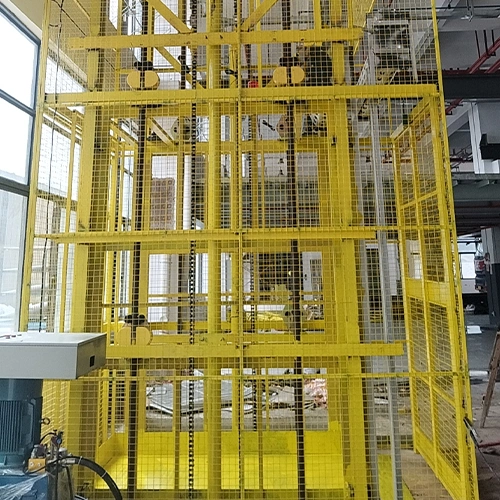
WEILINQINLI Hydraulic Cargo Lift
Safety and U.S. Installation Considerations
A hydraulic cargo lift should normally include safety features such as:
- Overload protection
- Upper and lower limit switches
- Emergency stop buttons
- Landing gates and door interlocks
- Anti-drop protection
- Emergency lowering or pressure-release protection
- Guardrails or a safety enclosure
- Non-slip platform surfaces
- Automatic or manual re-leveling
For U.S. projects, the equipment classification and local authority requirements should be confirmed before manufacturing or installation. ASME A17.1/CSA B44 is an important North American reference for the design, installation, operation, inspection, testing, maintenance, and repair of elevators and related conveyances. Maintenance procedures should also address hazardous energy control and lockout/tagout under OSHA 29 CFR 1910.147.
The U.S. Bureau of Labor Statistics reported 1,391 fatal work injuries among transportation and material-moving occupations in 2024, with a fatal injury rate of 12.5 per 100,000 full-time-equivalent workers. This figure is not specific to cargo lifts, but it shows why guarding, operator training, access control, and maintenance procedures should be treated as core specifications rather than optional accessories.
Which Cargo Lift Fits Your Application?
For light warehouse goods, a 500kg configuration may be a reasonable starting point. A 1t cargo lift is often considered for standard pallets, factory materials, and routine inter-floor transportation. A 2t cargo lift may be more appropriate for heavier machinery or concentrated industrial loads.
For mezzanines, production lines, warehouses, and factory renovations, the final design should be customized around the load, lifting height, number of stops, platform size, opening direction, indoor or outdoor environment, and available power supply.
Conclusion: Choose the Specification, Not Just the Capacity
A reliable hydraulic cargo lift is not selected by capacity alone. Capacity, lifting height, platform size, door opening, structural support, and safety configuration must work together as one system.
Use 500 lb, 500kg, 1t, and 2t as comparison points—not automatic recommendations. Before ordering, confirm the complete load, largest cargo dimensions, floor-to-floor travel, number of stops, loading method, available installation space, and applicable local requirements.
A preliminary site survey and layout drawing can prevent costly redesigns and help ensure that the selected lift performs safely and efficiently for the long term.
Need help selecting between a cargo lift 500kg, cargo lift 1t, or cargo lift 2t configuration? WEILINQINLI can evaluate your load and site conditions, prepare a preliminary layout, and provide technical consultation and a customized quotation. Send your project details to begin.
Frequently Asked Questions
Is there a standard hydraulic cargo lift platform size?
No. Platform size is usually customized according to the cargo footprint, loading equipment, door opening, and available installation space.
Is a 1t hydraulic cargo lift enough?
It depends on the complete load. Add the cargo, pallet, frame, tools, and handling equipment before selecting the rated capacity.
Can a hydraulic cargo lift be installed without a deep pit?
Some designs can be adapted for sites with limited pit depth or restricted floor openings. A site survey is required to confirm the foundation and installation method.
Can a cargo lift carry people?
A goods-only cargo lift should not be treated as a passenger elevator. People should only be transported when the equipment is specifically designed, approved, and operated for that purpose.
What information is needed for a quotation?
Provide the maximum load, cargo dimensions, pallet or cart size, lifting height, number of stops, platform preference, door opening, indoor or outdoor location, power supply, and site drawings or photos.